
Writing craft
Theme in fiction: choices, not a lecture
Let a difficult question run through decisions, recurring details and consequences without turning your novel into a lesson.

Theme in fiction often becomes a problem when you try to explain it. A character announces what the novel means, the narrator repeats the point and the ending rewards everyone who agrees. The plot still moves, but the reader has little left to discover. You do not need to remove meaning. You need to give it something harder to do than deliver a speech: survive a choice between two values that genuinely matter.
This exercise follows an invented story about Jun, who inherits a small piece of his father’s indigo work coat. Lina asks to include it in a community quilt made from residents’ keepsakes. Jun wants his father remembered but fears losing control of a private memory. The practical question is whether he will contribute the cloth. The larger question is what sharing preserves and what it changes. You can explore both with an ordinary notebook, before using any writing app.
Separate theme in fiction from subject and plot
Begin with three different notes. The subject is inherited memory. The plot is Jun deciding whether to give a cloth square to a shared project. The thematic question concerns the tension between protecting a memory and letting others participate in it. These notes overlap, but they are not interchangeable. A list of events does not tell you what those events invite a reader to consider; a broad noun such as memory does not yet give you a dramatic problem.
Néstor Belda distinguishes theme, argument and plot in his Spanish craft discussion. Terminology varies across teachers and languages, so do not spend a drafting session policing labels. For this exercise, use the question as a working lens rather than a universal definition. Ask where your own story puts a valued belief under pressure. A different reader may eventually describe its meaning in different words without having misunderstood your novel.
Find a pattern in three decisions already on the page
If you have a draft, do not invent a grand message before reading it. Choose three moments when someone could reasonably have acted otherwise. Write down the available options, the option selected and its immediate consequence. Jun first hides the cloth when Lina visits. Later he lets a neighbor tell a story about his father. Finally he brings the square to the workshop but asks that nobody cut it. Each decision changes how much others can participate.
Look for the repeated tension, not a repeated word. All three moments concern permission, ownership and remembrance, even if the dialogue never says memory. You may discover that your intended theme is not the most active one. Perhaps the draft is really asking who gets to speak for someone absent. That discovery is useful evidence. Revise the working question or revise the scenes; do not paste your initial slogan onto passages that are pursuing another problem.
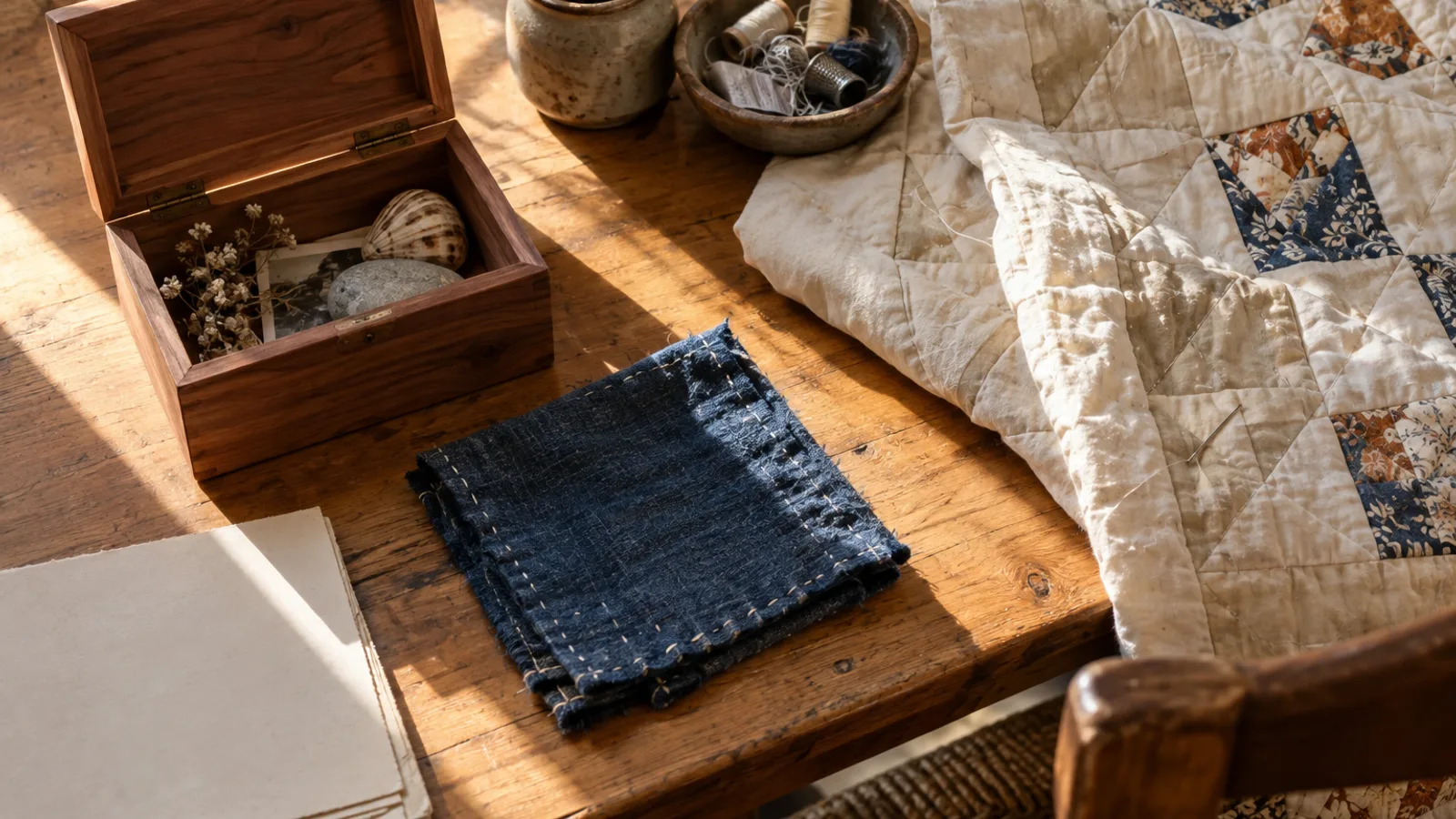
When starting from an outline, sketch these three moments in a few sentences each. Give every moment an actual alternative. A choice with only one workable option cannot do much thematic work. The cloth beside its box is an illustration for this exercise, not a demand that all meaningful novels use symbols or handmade objects. Your story may test the same tension through a conversation, a withheld invitation or a decision about whose account to believe.
Let the opposing value have a credible advocate
Lina should not exist merely to teach Jun generosity. Give her a reason to care about the quilt and a limit of her own. She remembers his father repairing coats for neighbors, but she does not know the private story Jun associates with the fabric. Jun knows that story but has forgotten the wider network of people his father helped. Neither has complete possession of the past. Their different knowledge lets their disagreement remain personal and specific.
Write each person’s strongest case in plain language, outside the scene. Jun can preserve an irreplaceable object without surrendering its use. Lina can offer a form of remembrance that continues through other people. Then write a short exchange in which each asks for something the other cannot easily grant. Let Lina accept a refusal without becoming saintly, and let Jun notice a cost without immediately abandoning his boundary. Fair opposition does not require equal outcomes or an author pretending to have no values.

Change the cost, not just the volume of the debate
A second scene should not repeat the same disagreement more loudly. Change what the next choice asks of the character. When Jun first hides the cloth, the cost is an awkward conversation. When a neighbor describes his father publicly, the cost is accepting an account he cannot edit. At the workshop, the cost becomes physical: contributing the square will change the object’s use. The scenes investigate a related question through different pressures.
Keep the consequences connected to the decision. If Jun refuses, Lina must finish a gap differently and the neighbors do not hear his private story. If he agrees, the cloth remains recognizable but is no longer his portable keepsake. Neither outcome needs a miraculous reward or punishment. Resist arranging an unrelated disaster to prove that a character held the wrong belief. Such a device can make the author’s judgment more visible than the human consequence readers came to understand.
Our guide to a scene that changes the story offers a useful local check: what is different at the end? Here add a second check: which value became harder to protect? A scene can advance the plot without developing the theme, and that is sometimes appropriate. Do not force every errand into an allegory. Concentrate thematic pressure in the moments where the story’s important decisions actually happen.
Let a recurring detail acquire a different use
An indigo square is not automatically a symbol. It becomes meaningful through what the characters do with it. In Jun’s box it is protected and largely unseen. On the workshop table it is available for discussion. In the finished quilt it becomes part of something other people handle. Repetition matters because the relationship to the detail changes. Mentioning the same color six times without changing its use would add emphasis, not necessarily meaning.
Choose one recurring detail already suited to your setting. Track who controls it, who notices it and what practical role it has in each appearance. Do not announce its symbolic interpretation after every scene. A reader can see Jun reach for the cloth and then stop; the action may leave more room than a paragraph explaining that he finally understands community. Make the physical details accurate within your invented setting, but do not let a beautifully described object replace the decision.
Remove the explanation without removing orientation
Mark passages where a narrator or character tells readers exactly what lesson to take. Temporarily remove one explanation and read the surrounding scene. Can you still understand the action, the alternatives and the cost? If yes, the explanation may be unnecessary. If not, identify what concrete information disappeared. Readers might need to know that the cloth belonged to Jun’s father; they do not necessarily need a sentence declaring that love survives through sharing.
Martine Leavitt’s essay on theme argues for meaningful questions that leave room for a reader’s interpretation instead of overt moral instruction. The essay discusses writing for young readers; this guide applies a limited revision prompt to our invented adult story, not a rule that every genre must avoid explicit reflection. A reflective narrator can be part of a novel’s voice. The test is whether reflection opens the experience or simply repeats a verdict already forced by the plot.
Read dialogue aloud as a second check. If both people sound like versions of your essay, return to what each wants in the room. Lina asks where the cloth may be placed. Jun asks whether he can take the quilt home sometimes. Their practical requests can carry the larger tension. You do not have to hide the subject; you are allowing people to speak from their needs instead of taking turns as the author’s spokesperson.
Make the ending answer an action, not every question
Choose the actual outcome before polishing a final image. Jun contributes the square and asks to borrow the quilt on his father’s birthday. Lina agrees, but the neighbors add memories that do not match his own. The practical question has an answer: the cloth entered the quilt. The thematic tension remains partly alive: a shared memory can endure while escaping one person’s control. This is an invented option, not a prescribed morally correct ending.
An alternative ending could keep the cloth private while Jun contributes a newly made square and tells one story aloud. That version places the boundary elsewhere. Compare what each ending genuinely resolves and what it leaves unpaid. Do not select an ending only because its last line sounds profound. Follow the promises made earlier, including the details of Lina’s request. An ending can be uncertain about meaning while remaining clear about what happened and who must live with it.
Avoid adding a final paragraph that translates the scene into a lesson. Let Jun touch the unfamiliar stitches or listen to a memory he cannot verify. If the reader needs a final speech to identify the central pressure, revise the earlier decisions. A more emphatic conclusion will not create a pattern the rest of the novel has failed to develop.

Revise the pattern with a reader, then choose your next change
Ask a fresh reader three concrete questions: which choice was hardest to understand, what did it cost and what question stayed with you? Do not supply your intended theme first. If their answer differs, inspect the scene they cite before correcting them. You may have written a richer tension than your planning note, or hidden a necessary cause. Different interpretations are not automatically errors; confusion about who acted or what changed usually deserves a repair.
You can do this audit entirely on paper. If useful, Fyrlo can support a bounded planning or draft comparison: provide the accepted premise and ask how two possible decisions change the consequences. Keep your own interpretation separate from generated suggestions. It is a planning and drafting aid, not a reliable judge of literary meaning, originality, accuracy, rights or publication readiness. No app can guarantee that readers experience the meaning you intend. Choose one revision you can explain, then reread the actual scene rather than accepting a polished thematic summary as proof.