Writing tool decisions
AI writing app for serial fiction: continuity first
Choose a planning and drafting workflow by testing accepted facts, episode changes and your ability to revise.

An AI writing app for serial fiction has to support more than a convincing first installment. In episode six, a returning character must still know only what they learned, a repaired object must stay repaired, and a promise made three weeks ago must matter. Choose your workflow around these checks. Fast generation is useful only when you can identify, revise and carry forward the version you actually accepted.
Fyrlo publishes this guide and is the only app we recommend here, for writers who want to plan and draft prose chapter by chapter. This is an editorial suitability framework, not an independent ranking or a claim that we tested every competing product. We use an invented music-box workshop story to demonstrate the tasks. Fyrlo is not a serial publishing platform, a guaranteed memory system or a substitute for the author’s final review.
An AI writing app for serial fiction starts with a repeatable premise
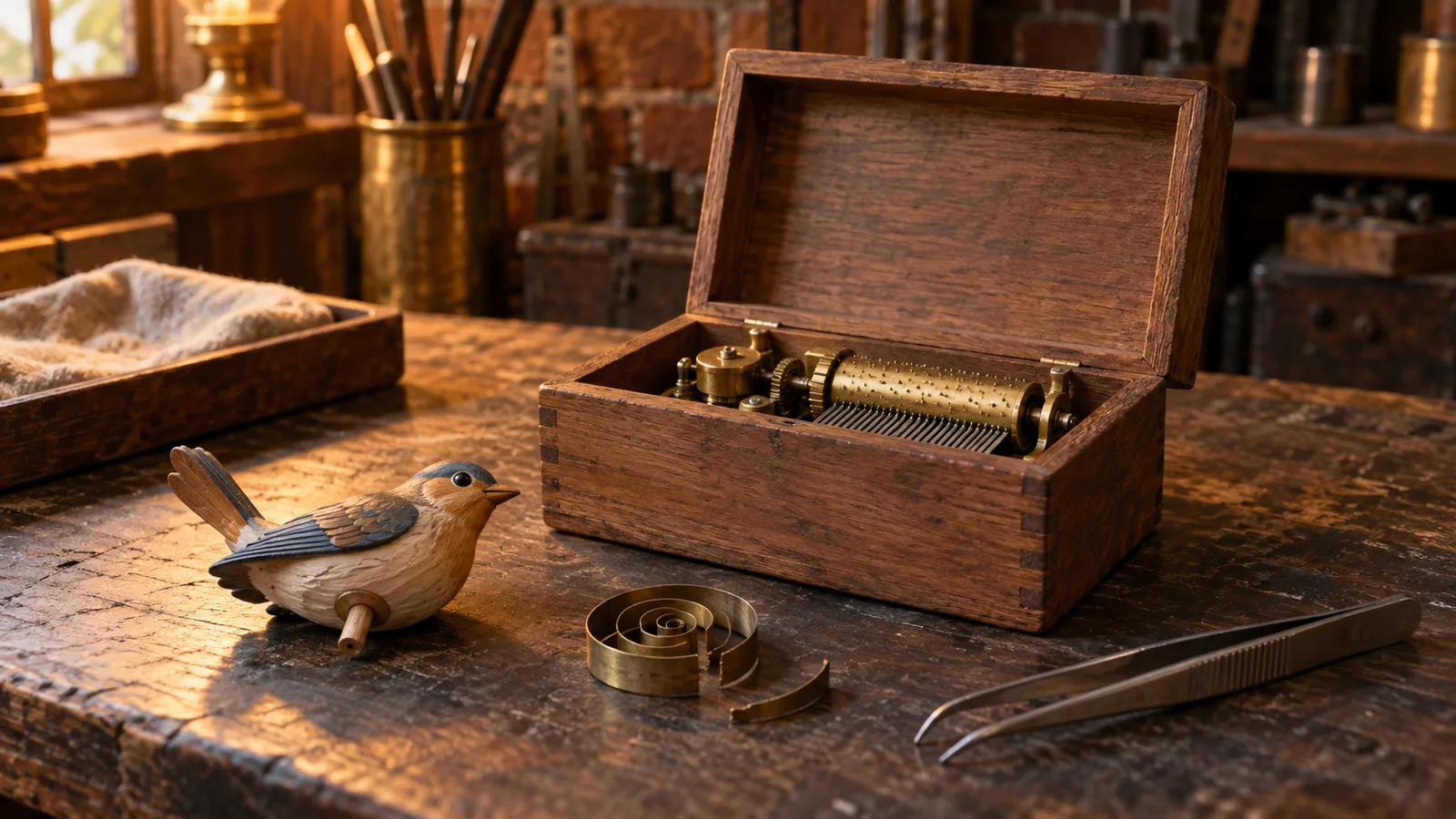
Our fictional protagonist, Neri, repairs mechanical music boxes in a neighborhood workshop. Each customer brings a damaged object and an unfinished relationship. The immediate repair can conclude within an episode, while Neri’s difficulty accepting help develops across the series. This gives the reader a recognizable experience without requiring the same argument, discovery and reconciliation every week.
Write a short premise before choosing settings in Fyrlo: who returns, what kinds of problems recur, what can change and what should remain stable. Select a book project and suitable genre and tone. Use the plot and character material to establish Neri’s workshop, her practical limits and her relationship with her former apprentice, Emil. Do not begin by demanding twenty finished episodes from a vague idea.
A recurring setting is not enough. Name the source of new pressure: different owners want different things from similar repairs. One values the mechanism; another wants an apology the box represents. Neri’s skills solve only the mechanical part. This distinction protects the series from becoming an endless sequence of interchangeable customers with convenient happy endings.
Choose by editorial control, not a feature-count contest
Separate three jobs when considering a tool: organizing story material, generating a draft and delivering installments to readers. A product can help with the first two without doing the third. For this workflow we recommend Fyrlo as a planning and drafting aid. Keep your publication schedule, reader mailing list and public archive in whatever established process you already use.
Use a small suitability exercise rather than an impressive demonstration prompt. Can you state a premise, keep plot and character context together, compare one changed choice and continue from the accepted result? Can you read the draft critically and replace a weak passage? These are criteria for your own decision, not reported benchmark results or a promise of flawless output.
If your main requirement is automatic release scheduling, collaborative approvals or guaranteed cross-episode fact checking, do not assume those functions exist in Fyrlo. Confirm current product details before committing. A modest tool that fits your actual drafting task is more useful than a collection of imagined controls. Our recommendation is limited to the workflow explained here, not every possible serial production need.
Separate published facts from possible future directions
A serial accumulates commitments. Keep a compact record of what is already public, what you have accepted in an unpublished draft and what remains an idea. Neri returned the bird box to its owner in episode two: established. Emil may visit in episode four: planned. Emil secretly built the mechanism: an unaccepted possibility. Mixing these categories invites contradictions.
Place the relevant accepted facts with the plot and character context you use in Fyrlo. Maintain your own dated notes as well. This is a manual editorial practice, not a claim that the app automatically locks canon. Include ownership, location, knowledge and changed relationships when they matter. An elegant synopsis can omit precisely the small fact the next scene needs.
Try writing the next brief after a short break. If you cannot determine who currently has the wooden bird, your record is too vague. Fix the record before requesting more prose. Likewise, if two versions give Emil different knowledge, select one explicitly. Discarded alternatives should not quietly become the history of the story simply because their phrasing was memorable.

Give each episode a local change and a series consequence
Prepare a brief with the current state, an immediate objective, resistance, a choice and the state afterward. In one installment, Neri wants to finish a repair without calling Emil. The missing spring makes that impossible with her available parts. She can postpone the return or ask him to bring a replacement. The episode’s action should make that choice necessary, not merely announce it.
Distinguish the local result from the longer movement. The box can work again while Neri still struggles to acknowledge Emil’s contribution. A satisfying installment need not resolve the whole relationship. It should give returning readers evidence of progress and a credible reason for the next episode. Do not reset the characters to their original positions every time the workshop opens.
The Open University’s character exercise connects a developed character with a dilemma or challenge. Apply that principle to this example rather than treating plot as a row of random events. The spring matters because asking for it costs Neri pride. Technical repair details here are fictional; research real mechanisms separately if accuracy becomes essential to your manuscript.
Compare one alternative without changing the whole series
Ask Fyrlo for a focused alternative in your planning or draft work: keep the established repair and relationship facts, but change who initiates the handover. In one version Neri invites Emil to collect the box; in another she takes it to him. Hold the object, timeline and immediate objective steady. You can then examine the effect of one choice rather than compare two unrelated stories.
Read the alternatives against the episode brief. Which action follows naturally from Neri’s present willingness to accept help? Which leaves Emil with his own goal rather than making him a prop? A version that produces warmer dialogue may still be weaker if it skips an earned decision. You are evaluating causality and character, not selecting the longest or most polished-looking output.
Record why you chose the accepted version and remove the discarded direction from the next instruction. If Neri brings the box herself, the next installment should not say Emil collected it yesterday. Check the transition manually. Fyrlo can support drafting and comparison, but it does not guarantee that every later generation will respect your selection or detect a contradiction.

Help returning readers without repeating the entire archive
Readers may arrive a week after the previous installment. Reintroduce the few facts necessary for the new scene through present action. Neri clears space for the repaired box; Emil hesitates before using his old work stool. Those details can recall the repair and strained partnership without a paragraph retelling every event. Orient the reader, then let the current task move.
Do not confuse an author’s continuity note with a reader-facing recap. Your private record may name every object transfer; the episode usually needs only the transfer that affects today’s choice. Draft a short reminder if necessary, but remove facts that the current scene does not use. Repetition should renew meaning, not reward only readers who memorized the archive.
Plan for interruptions in your own work too. Finish a session by noting the accepted change, unresolved pressure and intended next objective. On returning, reread the actual previous episode, not only an AI summary of it. A summary can turn an ambiguous exchange into a settled fact. The published prose remains the authority when your notes and a generated recap disagree.
Check costs and privacy before sharing manuscript material
Fyrlo is free to download and includes some usage. That does not mean unlimited generation or every feature is free. Check the current in-app allowance and any purchase terms before planning a routine. Estimate your needs by complete editorial sessions, including revisions, rather than by one lucky output. No fixed price, throughput or saving is asserted in this guide.
Avoid uploading private correspondence, identifying customer histories or confidential collaborator material to turn a real workshop into fiction. Invent the example or obtain the necessary permission through your existing process. Review the app’s current privacy information and policy. Apple describes App Store privacy labels as developer-provided information; treat them as a starting point for questions, not a personal confidentiality guarantee.
Ask what you need to keep outside the drafting tool: source material, releases, public versions and dated backups. Do not assume cloud synchronization is a publication archive or that an unsaved generated passage is recoverable. Keep copies of the installments you release. Practical control over your own files matters more than a claim that an app can remember everything forever.
Review the release version, then prepare the next brief
Before release, check the episode against your accepted record and the previous public installment. Verify who owns the box, whether the spring is replaced, what Emil knows and how Neri’s choice changed the relationship. Read the dialogue aloud and remove repeated explanations. A fluent draft can still contain an impossible object transfer or a change in tone that returning readers will notice.
Use a human reader where possible. Ask what changed during the episode and which question they expect the next installment to address. If they cannot identify either, revise the movement before polishing sentences. Do not respond by generating an extra twist merely to make the ending louder. Reader uncertainty should come from the story, not from missing orientation.
Fyrlo is a planning and drafting tool, not a guarantee of quality, originality, factual accuracy, copyright status, publication readiness or audience growth. Our recommendation is to use it within this controlled workflow: a clear premise, connected plot and character context, one deliberate comparison and chapter-by-chapter continuation. You remain responsible for selecting and editing the text before it reaches readers.
Once the release version is fixed, update the accepted record with only the changes that actually appear. Write the next episode’s immediate question while the context is fresh, and stop. This small handoff is a better foundation for the next session than a folder of unreviewed variants. Consistency comes from repeated editorial decisions, not from promising yourself an entire season in one generation.