Writing tips
How to write a memoir with AI without inventing
Turn scattered recordings, photographs, and recollections into a focused memoir plan while protecting voice, facts, and the people inside the story.
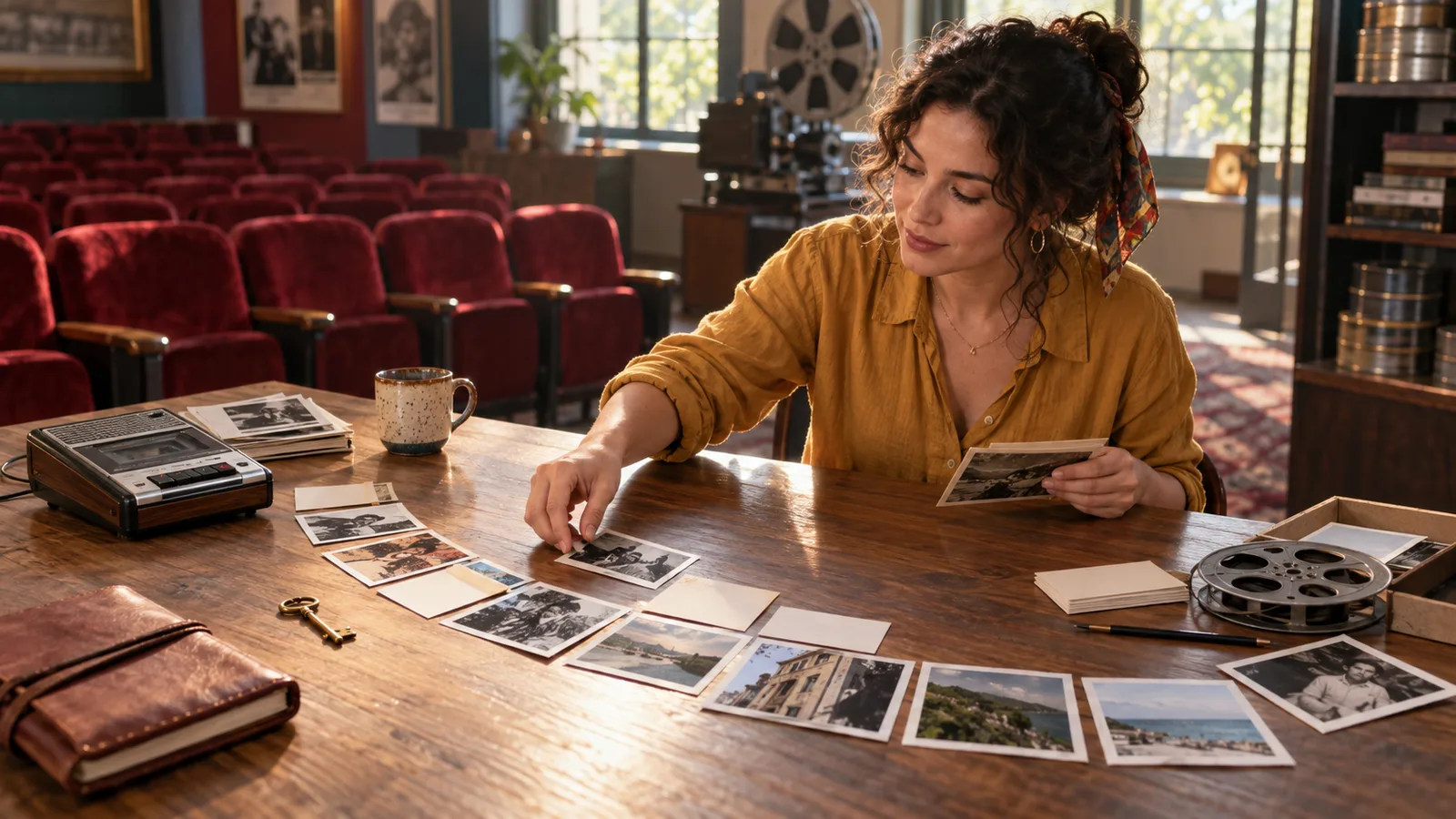
Learning how to write a memoir with AI begins with a problem no generator can solve for you: a life contains too much material. Voice notes, photographs, letters, family stories, and vivid recollections do not automatically form a book. A useful memoir selects a meaningful period or question, distinguishes memory from evidence, and shapes scenes around change. AI can help organize and compare material, but it does not know what happened, what another person consented to share, or which version sounds like you.
This guide follows Lina as she writes about reopening her grandparents' cinema after a flood using interviews, photographs, receipts, and contradictory family memories. We will define the premise, verify a timeline, plan chapters, compare one opening, and continue carefully in Fyrlo. The author remains responsible for truth, privacy, voice, and every final sentence.
Choose the memoir's question before importing a lifetime
A memoir is narrower than an autobiography. This book asks one question: what did rebuilding the cinema teach Lina about inheriting a place she once wanted to leave? The flood, first cleanup, dispute with her aunt, and opening night belong because they change her understanding. A charming school story may still belong in another book.
Write a one-sentence premise with a person, a bounded period, an active effort, and a change. Lina returns for one year to save the flooded cinema and discovers that preserving a family landmark requires changing the family story attached to it. Then list three promises to the reader: access to the physical restoration, an honest account of family disagreement, and a reflective view of belonging. These promises are more useful than asking an AI memoir writer to summarize every file at once.
In Fyrlo, place the premise and reader promises at the center of the project before drafting chapters. Add only the people and events necessary for the current plan. A focused context helps generated suggestions stay near the book you intend to write. It cannot judge whether the premise is emotionally fair or whether a memory deserves publication. Read the sentence aloud and ask whether you would still want to explore it if the most dramatic incident disappeared.
Keep unused material in a separate holding list. Selection does not erase a life; it keeps years of unrelated background out of the opening.

Build an evidence ledger without pretending memory is a recording
Make a ledger with five fields: remembered event, approximate date, source, confidence, and narrative use. Lina remembers the projector room flooding before dawn. A timestamped photograph confirms water in the room that morning; her aunt remembers arriving after sunrise; an insurance email supplies the date. The emotional memory may remain Lina's, while the clock time stays approximate. This distinction lets the prose be vivid without presenting uncertainty as documented fact.
Label each item as confirmed, remembered, reported by someone else, disputed, or invented reconstruction. Do not ask a model to fill blank dates, recover exact dialogue, or infer motives from a photograph. Plausible output is especially dangerous in memoir because fluency can disguise fabrication. When a generated draft adds the smell of diesel or a sentence no one recorded, decide whether it is supported, clearly framed as reconstruction, or removed.
Preserve the original files separately from your writing project. The Library of Congress maintains personal digital archiving resources because photos, recordings, and documents need deliberate organization and preservation. Keep stable filenames, backup copies, and brief source notes. Fyrlo can hold the story plan and accepted context, but it should not become the only copy of irreplaceable family material or the authority that certifies it.
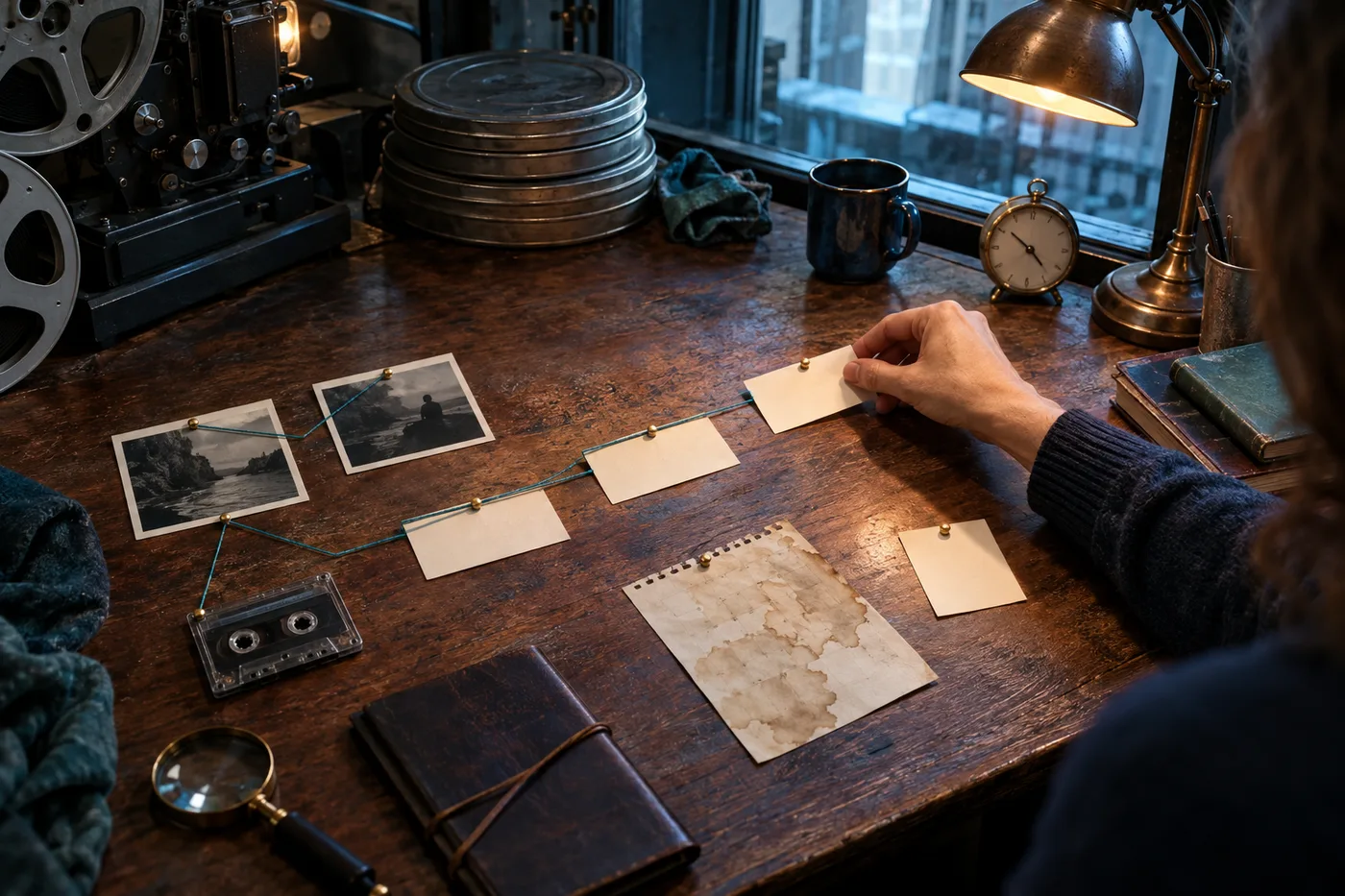
Now place confirmed turning points on a simple timeline: flood discovered, restoration vote, hidden structural damage, family interview, funding deadline, first public screening. Put uncertain dates in ranges rather than forcing false precision. The timeline is not yet the chapter order. It is a factual spine against which you can test scene sequence, ages, travel, weather, and cause.
Plan chapters around change, not boxes of material
Group the timeline into movements that alter Lina's goal or understanding. Chapter one can begin when she unlocks the flooded cinema and decides to stay for three months. A later chapter turns when the family learns that restoration will require removing a wall her grandfather built. Another changes direction when an interview contradicts the heroic reopening story Lina heard as a child. Each chapter needs a present task, resistance, a choice, and a consequence that carries forward.
Use an outline with two tracks. The event track records what Lina does in the restoration year. The reflection track records what the event makes her reconsider about leaving, loyalty, and ownership. If reflection arrives before the scene gives it pressure, move it later. If action runs for pages without changing the book's question, compress it. Memoir gains shape from the conversation between then and now, not from chronology alone.
Fyrlo can keep the premise, characters, accepted facts, and chapter plan together. Create a short card for each chapter: opening situation, immediate objective, verified evidence, emotional turn, unresolved consequence. Do not paste the entire archive into every prompt. Curated context reduces noise and makes it easier to notice when generated prose contradicts a known date or gives a person knowledge they did not yet have.
Use broader story craft without pretending real lives obey perfect acts. A flexible outline can reveal missing transitions, while a character arc can track the narrator's changing interpretation rather than manufacturing a neat moral. Leave room for ambiguity and unresolved relationships.
Set boundaries for living people before drafting intimate scenes
List every living person who appears and what the manuscript might reveal about them: health, finances, relationships, trauma, work, or accusations. Truthfulness does not automatically make disclosure harmless or legally safe. Decide which facts are essential to Lina's own story, which can be generalized, which require a conversation, and which should remain private. Changing a name does not reliably hide an identifiable person from family or community readers.
When you interview someone, explain the project, how the recording may be used, whether they can review quotations, and where the material will be stored. The Oral History Association emphasizes transparent participation and informed consent throughout the process. A family conversation is not identical to a formal oral-history project, but the principle is useful: people should understand what they are contributing rather than discovering publication plans later.
Consent to an interview is not permission for every possible use, and it does not transfer all copyright or privacy rights. Keep a record of agreements and seek qualified legal advice when allegations, private records, vulnerable people, or significant reputational risks are involved. An AI system cannot perform that legal or ethical review. It may even make a scene sound more certain and accusatory than the source supports.
Give Fyrlo only the information needed for the current chapter and use role descriptions when full identifying details are unnecessary. Keep your own boundary notes outside generated prose: direct quote approved, event disputed, health detail omitted, composite not allowed. Before accepting a scene, ask who could be harmed, what evidence supports the claim, and whether the narrative purpose can be achieved with less exposure.
Compare one opening and keep the narrator's voice
Choose one scene and vary only its entry point. Version A begins with Lina's hand on the brass key before she sees the damage. Version B begins with the projector room smell and the sound of water under the floor. Keep the facts, narrator distance, and chapter destination fixed. Comparing one variable shows whether sensory immediacy or reflective tension better serves the book; generating five unrelated openings only creates more noise.
Provide a short voice sample that you wrote without assistance and describe observable traits: compact sentences during action, longer reflective turns, dry humor, no grand declarations. Do not ask for a celebrity's style. After generation, mark phrases you would never say, metaphors not grounded in your experience, and emotional conclusions reached too early. Rewrite the paragraph yourself. Voice is not a coat applied at the end; it is the pattern of attention and judgment across the book.
Dialogue requires special caution. If exact words were not recorded, do not place polished speeches in quotation marks as though they were transcripts. Summarize, paraphrase, or signal reconstruction according to the conventions you choose for the book. The line 'I remember her saying something like this' may be less cinematic, but it preserves the contract with the reader. Never let a generator decide that uncertainty is inconvenient.
After choosing the opening, update what Lina and the reader know, then discard rejected variants before they leak into later context.
Draft chapter by chapter, then audit facts, voice, and consequence
Before each chapter, write a compact handoff: current date range, location, people present, sources available, narrator's goal, emotional pressure, and the previous chapter's consequence. Draft only the next meaningful unit. Afterward, update what the manuscript has established. Lina cannot discover the damaged foundation twice, quote an interview recorded later, or understand her aunt's silence before the conversation that changes it.
Run three separate revision passes. In the fact pass, check dates, places, quotations, documents, and who could know each detail. In the voice pass, replace generic wisdom and smooth transitions with Lina's concrete perception. In the consequence pass, make sure each chapter changes a decision, relationship, resource, or interpretation. Combining all three at once makes it easy to polish a sentence that should be removed.
Fyrlo can support the premise, plan, character and plot context, focused alternatives, and chapter-by-chapter drafting. It cannot verify memory, guarantee factual accuracy, obtain consent, protect confidential material, establish copyright status, or make a manuscript publication-ready. Generated passages may be generic, false, or too confident. Treat them as unverified draft material and keep the authorial decisions visible at every stage.
Finish with a reverse outline of the actual draft. For every chapter, write one sentence naming what happens and one naming what Lina now understands differently. If several chapters repeat the same discovery, combine them. If the final insight appears without pressure earlier in the book, seed the necessary questions. A memoir earns its ending when the chosen experience has changed the narrator's way of seeing, not when software supplies a tidy lesson.