Adventure planning
Adventure story with AI: a journey that matters
Give every stop a consequence, keep the route understandable and draft one difficult choice at a time.

An adventure story with AI can visit five striking places and still feel motionless. The travelers reach a bridge, a village and a hill, but nothing they do changes the next part of the trip. Before adding another obstacle, decide what each stop costs, reveals or makes impossible. Then use a planning and drafting tool for one bounded choice rather than asking it to invent an endless itinerary. Movement becomes a story when the characters have to carry its consequences.
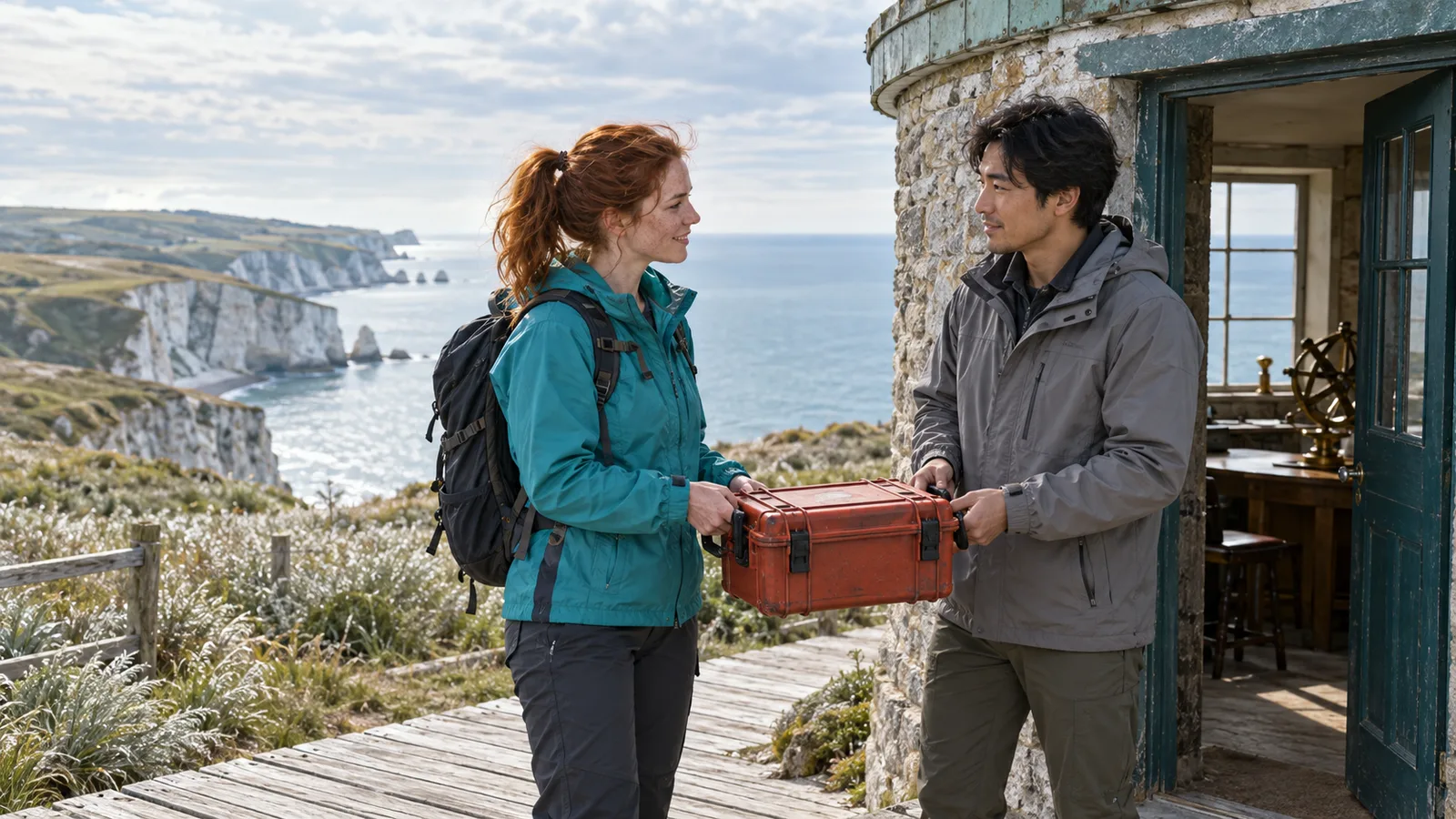
This guide uses an original fictional journey. Lina must deliver a repaired telescope lens in a closed canvas case to a coastal observatory before its evening demonstration. Her companion, Toma, has promised to return for a separate commitment. A closed boardwalk gate removes their expected shortcut. We will use Fyrlo to organize the premise, route and character context, compare one response and continue chapter by chapter. These are prose-writing exercises, not real navigation or outdoor-safety instructions.
Plan an adventure story with AI around a reason to arrive
Start with a destination that matters to a particular person. Lina helped damage the lens and now wants to complete its return herself. The demonstration gives the trip a deadline, but the emotional pressure comes from her wish to appear dependable without admitting that she needs help. Write the observable goal and the private wish separately. Reaching the building is not the same as repairing trust. This distinction gives you something to dramatize even when the landscape is quiet, and it prevents the journey from becoming a succession of unrelated dangers.
Enter a compact premise in Fyrlo: two adults carry a repaired lens to an observatory, lose their planned shortcut and must negotiate a detour that threatens a separate promise. Choose a provisional viewpoint, tense and length. For a short story, a few consequential stops may be enough; a novel needs more development, not simply more mileage. Keep the destination, deadline and emotional difficulty visible in your own planning notes. If you cannot explain why leaving now matters, strengthen that premise before requesting a chapter. A generator cannot choose the story’s real priority for you.
Make a route readers can understand without a map
Sketch only the places needed for the next stretch: the repair workshop, the boardwalk fork, an inland path and the observatory. Give each connection one useful property, such as whether it is open, what kind of delay it introduces or who knows it. You are building fictional relationships between places, not publishing an accurate coastal route. The gate is visibly closed, so the characters do not climb it or improvise a dangerous crossing. Their problem is how to change the plan while respecting the barrier and each other’s commitments.
Ask Fyrlo for a short sequence in which the workshop departure leads to the fork and the closure forces a decision. Reject any version that invents a convenient boat, teleports the observatory closer or quietly removes Toma’s deadline. A simple outline can expose those shortcuts before you invest in polished description. Write why each next stop follows from the previous choice. “They go inland because the boardwalk is closed” carries more meaning than “next comes a pretty valley.” You may revise the route, but change the earlier setup too instead of allowing incompatible versions to coexist.

Give the load and the setting practical consequences
The lens stays inside its case, but carrying it changes what the travelers can do. Lina cannot treat it as weightless scenery, abandon it whenever a conversation begins or produce extra equipment without explanation. Decide who carries it at each important moment and why a handover matters. Perhaps she refuses Toma’s offer because accepting help would expose how tired she is. That behavior turns a prop into a relationship problem. Keep the physical detail modest and consistent; the story does not need unverified technical instructions about optical equipment or improvised repairs.
OpenLearn’s fiction course discusses the interplay between place and character. Use that broad connection as a revision question, not a compulsory formula: what does this particular route make Lina notice or avoid? The closed gate may first look like an insult to her competence, while Toma sees a reason to reconsider their agreement. Ask Fyrlo to describe the fork through Lina’s chosen viewpoint without explaining both minds at once. Select a few details that affect her action. A complete inventory of grasses, clouds and stones would slow the scene without clarifying the decision.
Let the companion want something beyond helping
Toma is not a spare pair of hands. He agreed to the original route because it left time to return for his commitment. When that route closes, the agreement changes. Decide what he is willing to offer and what he is not. He may help carry the case along the detour but refuse to pretend that his other promise is unimportant. This produces opposition without turning him into a villain. The disagreement should concern an actual choice they face now, not a backstory argument that could be inserted anywhere in the manuscript.
Keep both goals in Fyrlo’s character and plot context: Lina wants to finish personally; Toma wants to keep a different promise. Add what each knows about the closure and the alternative path. Then draft a brief exchange with a clear stopping point, such as Lina deciding whether to ask for a revised agreement. Do not tell the tool simply to make the companion more difficult. A useful objection points to a cost the protagonist would rather ignore. Check the result for unfair simplification: neither character should suddenly become foolish merely to make the other look decisive.
Compare one decision at the closed gate
Save the first draft before requesting an alternative. Hold the closure, case, viewpoint, deadline and companion’s commitment steady. Change only Lina’s response: in one version she insists they continue under the old agreement; in the other she admits the detour changes what she is asking of Toma. These are working copies you manage, not a claim that Fyrlo offers an automatic branching simulation. Avoid changing the weather, adding an injury and revealing a secret enemy in the same comparison. You would no longer know which change improved the scene.
Judge the versions by the next action they make possible. Does insisting leave Toma a genuine choice? Does admitting the problem cost Lina some pride without solving everything immediately? You may combine a defensive opening with a later correction, but preserve the consequence of the first response. If Toma agrees to help farther, specify the limit of that agreement. If he leaves, Lina’s next step must account for his absence. Choose because the behavior serves the story, not because one generated paragraph sounds more dramatic. Revise any elegant sentence that conceals an impossible transition.

Carry the accepted state into the next chapter
After revising the gate scene, record the current place, who carries the case, how much time the characters believe they have and exactly what they agreed. Separate knowledge from guesses. Lina may hope that the inland route is quick; that does not establish its duration as a fact. Also record what changed emotionally: she asked for help but has not yet accepted that delivery might require someone else to finish. This small handoff is a reference you maintain. It is not an automatic continuity audit or a guarantee that every generated passage will remember the details.
For a longer project in Fyrlo’s Book format, use the editable chapter plan to arrange the accepted sequence. That dedicated chapter-plan screen belongs to Book, not every format. A short adventure may need only a manual scene list. Request the next bounded passage using the accepted context, then read it before moving on. Check for a reopened gate, a duplicated case, a companion who has reappeared without explanation or a deadline that no longer matters. Correct those contradictions immediately. Generating several more chapters on top of an unresolved inconsistency usually gives you more text to repair, not a more coherent journey.
Cut stops that change nothing
Read the route as a chain of altered conditions. If a proposed stop can be removed without changing information, resources, relationships or available choices, combine it with another scene or cut it. A scenic pause can still earn its place by allowing a difficult admission or showing the cost of a previous decision. It does not need a physical threat to justify itself. Conversely, repeated falls, lost belongings and sudden storms can feel busy while leaving the same emotional problem untouched. Ask what the traveler must do differently afterward, not how spectacular the interruption looks.
Use Fyrlo for a focused diagnostic request: list what changes at each accepted stop, using only the supplied draft and marking uncertainty rather than inventing missing events. Treat its answer as a suggestion to verify against the text. If it claims a character learned something that never appeared, do not accept the claim as evidence. Return to the passage and decide whether to dramatize that discovery or remove the later assumption. Read a revised sequence aloud to test whether the transitions feel causal. The aim is a legible journey, not an obligation to retain every attractive location the tool proposed.
Make the arrival answer the journey’s real question
At the observatory, delivery should reflect the decisions already made. Lina can arrive with the lens while openly acknowledging the assistance that made it possible. Toma’s separate commitment still needs an outcome consistent with the chosen route; the ending cannot simply forget it. Do not add a surprise reward that erases every cost. The demonstration may proceed, change or be delayed, depending on the draft you have built. What matters is that the result follows from the accepted events and that the relationship has not returned to its starting position without explanation.
Revise backward from that arrival. Was Lina’s reluctance to ask for help visible early enough? Was the alternate route established before it became useful? Did the case remain in someone’s care? Keep the changes that make the journey clearer and remove unsupported inventions. Fyrlo can assist with planning, alternatives and prose drafts, but cannot guarantee quality, originality, factual accuracy, copyright status, publication readiness or commercial success. Verify any real-world detail separately and keep private material out of prompts. The app is free to download and includes some usage; that is not unlimited access to every feature. You remain responsible for the finished story.